
Types of Chimney Caps: Every Style Explained
Key Takeaways
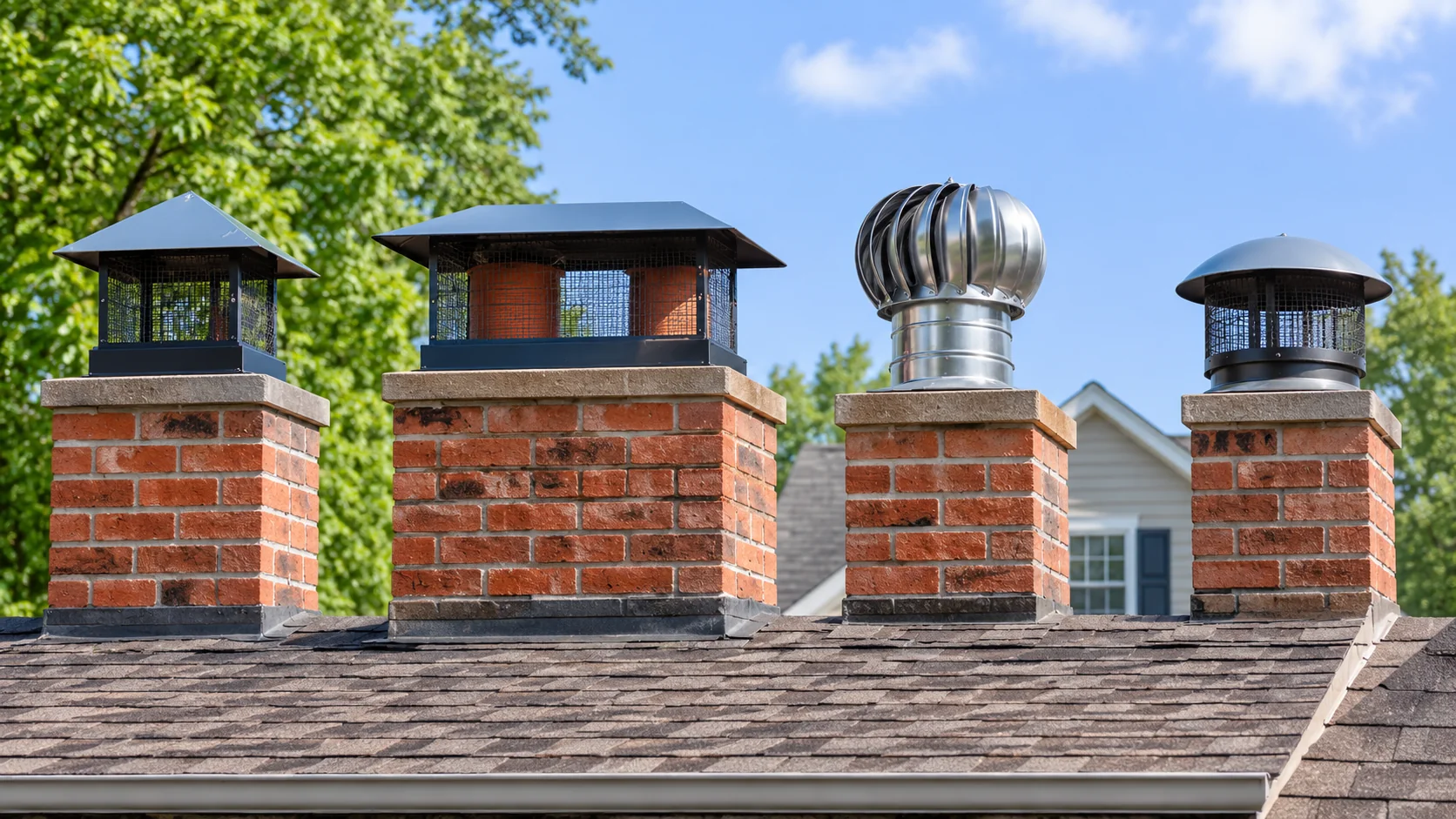
- Chimney caps are grouped by what they fit (single flue, multi flue, round liner, prefab pipe), what they do (rain, wind, sparks, sealing) and how they look (standard, decorative, shroud, pot).
- Single flue caps cover one flue; multi flue caps cover the whole crown.
- Wind directional caps rotate with the wind; draft inducing caps like the Vacu-Stack create suction with no moving parts.
- Top mount damper caps combine a cap with a damper that seals the flue when the fireplace is not in use.
- A chimney cowl is mostly a British term for a chimney cap, often an anti-downdraft or bird guard design.
There are more types of chimney caps than most homeowners expect. Some are defined by the flue they fit, some by the problem they solve, and some by how they look. Picking the right type is the first step toward picking the right cap.
This guide explains every common type, what it is for, and which chimneys it suits. When you know your type, the matching guide on this site compares real models.
How Chimney Caps Are Grouped
It helps to think of chimney caps in three groups:
- By fit: single flue, multi flue, round liner, oval, prefab pipe, B-vent.
- By function: rain cap, wind directional, draft inducing, spark arrestor, top sealing damper.
- By style: standard, decorative, shroud, chimney pot.
Most real caps belong to more than one group. A stainless single flue cap with 5/8 inch mesh, for example, is a rain cap and a spark arrestor.
Single Flue Chimney Caps
A single flue cap covers one flue. It is the most common cap in the United States.
How It Attaches
- Bolt-on: a skirt slides over the outside of a clay tile and bolts tighten against it. The HY-C Shelter stainless cap uses 16 gauge base flanges with slotted hex head bolts.
- Band or clamp: a strap wraps around the tile and tightens.
- Slip-in: a collar slides inside a round liner.
- Screw-on or twist lock: for metal pipe.
Shapes
Single flue caps come in square, rectangular, round and oval versions to match the flue.
Best for
Chimneys with one flue, or with flues far enough apart to fit a cap on each. Compare models in the best chimney cap guide.
Multi Flue Chimney Caps
A multi flue cap is one large cap that sits on the crown and covers several flues at once. It covers most of the crown too, which keeps rain off it.
Mount Styles
- Top mount: sits on the flat crown and is fastened with anchors or adhesive.
- Outside mount: wraps over the edge of the crown.
Best for
Chimneys with two or more flues close together, or with a crown that needs protecting. Multi flue chimney caps also protect the crown, which single caps can’t.
Round, Square and Oval Chimney Caps
The shape of the cap must match the flue.
| Flue | Cap shape | Typical use |
|---|---|---|
| Square clay tile | Square cap | Older fireplaces, furnace flues |
| Rectangular clay tile | Rectangular cap | Most fireplace flues |
| Round stainless liner | Round cap | Relined chimneys, stoves |
| Round metal pipe | Round cap from the pipe maker | Class A, prefab, B-vent |
| Oval liner | Oval cap | Relined fireplace flues |
Round vs Square: Which Is Better?
Neither shape is better on its own. A round cap is right for a round flue and a square cap for a square flue. Using a square cap on a round liner, or the other way around, leaves gaps for animals and water. The how to measure for a chimney cap guide shows how to check your flue shape.
Rain Caps
Almost every chimney cap is a chimney cap for rain at heart, because the solid lid keeps water out. Some caps are marketed specifically as rain caps and have wider lids or pitched tops to shed more water.
Wind Directional Chimney Caps
A wind directional cap has a hood that is open on one side and a vane on the other. The wind pushes the vane so the closed side faces the wind and the open side faces away. Smoke leaves on the sheltered side.
Examples include Chimcare’s rotating caps, listed as 304 stainless, and Luxury Metals wind directional caps in stainless or galvanized from 4 to 12 inches.
Rotating Chimney Caps
“Rotating cap” usually means a wind directional cap, but it can also mean a turbine style cap that spins in the wind. Turbine caps are more common on attic and kitchen vents than on fireplace chimneys. For chimneys, a rotating wind directional cap is the usual choice.
Fixed vs Rotating Caps
| Fixed cap | Rotating cap | |
|---|---|---|
| Moving parts | None | Bearing or pivot |
| Maintenance | Low | Bearing needs cleaning |
| Downdraft control | Basic (standard) or strong (draft inducer) | Good in steady wind |
| Problem conditions | Rarely sticks | Can stick with creosote or ice |
Draft Inducing Chimney Caps
A draft inducing cap uses its shape, not moving parts, to create suction. Wind passing around it from any direction lowers the pressure at the outlet and pulls smoke up. The Vacu-Stack is the best known example, made from type 304 stainless in round, oval and air cooled versions.
Draft inducers are a fixed alternative to rotating caps and work in gusty, shifting winds. They are also used where a cap must improve draft, not just protect it.
Spark Arrestor Caps
A spark arrestor cap has mesh fine enough to stop most embers. Every cap with mesh does this to some degree, but where a spark arrestor is required, the mesh must meet code: IRC style rules call for openings that stop a 1/2 inch sphere and pass a 3/8 inch sphere, with net free area at least four times the flue.
Animal Guard Caps
An animal guard cap is a standard cap built with strong mesh and secure fasteners to keep out birds, raccoons, squirrels and bats. Any well fitted cap with 3/4 inch or smaller heavy mesh does this.
Top Mount Damper Caps
A top mount damper, also called a top sealing damper, is a metal lid with a gasket that sits on top of the flue and is opened and closed by a cable or chain that runs down to the fireplace. Many are built into a cap with mesh sides.
How It Works
- Open: the spring holds the lid up and smoke leaves through the mesh.
- Closed: you pull the cable and the lid seals against the top of the flue with a gasket.
Benefits
- Seals better than a traditional throat damper, which can warp and leak.
- Keeps the flue warm in winter by stopping cold air from sinking down it.
- Keeps rain and animals out when closed.
Things to Know
- It must be opened before every fire. Many have a warning tag on the cable.
- The cable runs down the flue and needs a mounting bracket in the firebox.
- Not suitable for every chimney or fuel. Follow the maker’s limits.
Brands such as Lock-Top and Lyemance make top sealing dampers. They are usually installed by chimney sweeps.
Chimney Cap vs Chimney Damper
A cap stays open and protects the top. A damper opens and closes. A traditional damper sits low in the throat of the fireplace. A top mount damper sits at the top and can include a cap. Many homes have a throat damper and a separate cap.
Chimney Cowls
“Cowl” is the usual British and Irish term for a chimney cap. In the UK, cowls are sold for specific jobs: rain cowls, bird guards, anti-downdraft cowls, spinning cowls and cowls for gas or solid fuel. Searchers in the United States sometimes use “chimney cowl” to mean a decorative or anti-downdraft cap.
Chimney Cap vs Chimney Cowl
For practical purposes they are the same thing. The difference is mostly the name and the style. UK cowls often fit into clay chimney pots, while US caps usually bolt to clay tiles or sit on the crown.
Chimney Caps for Prefab and Metal Chimneys
Factory built chimneys use caps designed for that pipe, such as the DuraVent DuraTech caps from 6DT-VC to 16DT-VC1, or DuraPlus caps for triple wall pipe. These are a type of their own, because they must match the chimney’s listing.
B-vent Caps
Type B gas vents for natural draft gas appliances use round caps made for B-vent pipe, such as DuraVent’s Type B caps. They are lighter than chimney caps and designed for gas flue temperatures.
Direct Vent Termination Caps
Direct vent gas appliances use a termination cap supplied by the appliance maker. It manages both exhaust and fresh air intake and must not be replaced with any other cap.
Chase Covers
A chase cover is the metal top of a wood framed chase around a prefab chimney. It is not a cap, but it works with one.
Decorative Caps, Shrouds and Chimney Pots
Decorative Caps
Standard caps made in premium materials or with styled lids, such as copper caps with scalloped corners.
Shrouds
Decorative chimney caps, or shrouds, are housings that sit over the top of a chimney, usually a prefab chimney, to hide the pipe and cap. A shroud is not a rain cap, and on factory built chimneys it must be listed for that system.
Chimney Pots
Clay or metal extensions on top of a masonry flue that add height and character.
Chimney Caps by Material
Any type of cap can come in several materials. The main ones:
| Material | Strengths | Limits |
|---|---|---|
| Stainless steel | Rust resistant, all fuels, long life | Costs more than galvanized |
| Copper | Very long life, premium look | Highest price, green runoff |
| Galvanized steel | Lowest price | Rusts when coating wears |
| Aluminum | Light, does not rust | Mainly gas vents |
For most homes I’d pick stainless steel, choose copper only when looks matter, and keep galvanized for gas flues on a tight budget.
How to Choose the Right Type
Work through these questions:
- What chimney do you have? Masonry, prefab or B-vent. Prefab and B-vent narrow the choice to listed caps.
- How many flues? One flue: single flue cap. Several close together: multi flue cap.
- What shape is the flue? Square, rectangular, round or oval.
- What is the main problem? Rain, wind, animals, sparks or heat loss.
- Does the chimney show? Consider copper, a shroud or a pot.
| If your main concern is | Choose |
|---|---|
| Rain | A wide lid single flue or multi flue cap |
| Wind downdraft | Wind directional or draft inducing cap |
| Animals | Heavy mesh cap with secure fastening |
| Sparks | Spark arrestor cap with code compliant mesh |
| Heat loss when the fireplace is off | Top mount damper cap |
| Looks | Copper cap, shroud or chimney pot |
Common Type Mistakes
- Putting a masonry cap on metal pipe. Use the listed cap.
- Using a single flue cap on one of two close flues. The other flue stays open, and the caps may clash.
- Expecting a shroud to keep rain out. It needs a rain cap underneath.
- Choosing a rotating cap in an icy, high creosote setting. A fixed draft inducer may be better.
- Using a top mount damper without a warning system. Forgetting to open it before a fire fills the house with smoke.
Which Type Is Most Common?
In the United States, the most common chimney cap is a stainless or black galvanized single flue cap that bolts to a clay tile. Multi flue caps are next on masonry chimneys, and listed round caps dominate on prefab and stove chimneys.
Chimney Cap Types by Fuel
| Fuel | Good choices | Avoid |
|---|---|---|
| Wood fireplace | Stainless single or multi flue cap, spark arrestor where required | Galvanized, aluminum |
| Wood stove or insert | Stainless liner cap with removable screen | Very fine mesh without regular cleaning |
| Pellet stove | The vent cap listed for the stove’s pipe | Unlisted caps |
| Gas fireplace (masonry flue) | Stainless cap with 3/4 inch mesh | Fine mesh that can ice up |
| Gas appliance (B-vent) | The listed B-vent cap | Masonry style caps |
| Direct vent gas | The maker’s termination cap | Any substitute |
| Oil | Stainless or copper | Galvanized, aluminum |
Chimney Cap Types by Problem
| Problem | Type to consider |
|---|---|
| Rain in the firebox | Cap with a wide lid; multi flue cap over the crown |
| Animals | Animal guard cap with intact 3/4 inch mesh |
| Sparks | Spark arrestor cap |
| Wind downdraft | Wind directional or draft inducing cap |
| Heat loss when fireplace is off | Top mount damper cap |
| Cracked crown | Multi flue cap, after crown repair |
| Rusty chase | Stainless chase cover plus listed cap |
| Plain looking chimney | Decorative cap, shroud or chimney pot |
Chimney Cap Types by Climate
- Wet climates: wide lid, stainless or copper.
- Coastal: 316 stainless or copper.
- Very cold climates: 3/4 inch mesh to reduce icing, sturdy fastening for snow.
- Windy sites: wind directional or draft inducing caps, strong fastening.
- Wildfire areas: spark arrestor caps that meet local code.
Pros and Cons of Each Type
| Type | Pros | Cons |
|---|---|---|
| Single flue | Simple, affordable, easy to fit | One per flue; does not protect the crown |
| Multi flue | Covers several flues and the crown | Costs more; must be anchored; may need custom size |
| Wind directional | Reduces wind downdraft | Moving parts need care |
| Draft inducing | Helps draft in gusty wind with no moving parts | Costs more than standard caps |
| Spark arrestor | Catches embers | Fine mesh clogs faster |
| Top mount damper | Seals flue when not in use | Cable and gasket maintenance; must be opened before a fire |
| Decorative | Adds style | Prefab versions must be listed; higher cost |
| Chase cover | Protects framed chase | Only for prefab chimneys |
How Types Combine
Most real caps combine several features. For example:
- A stainless multi flue cap can also be a spark arrestor with the right mesh.
- A single flue cap with a wide lid is both a rain cap and an animal guard.
- A decorative copper shroud may also have spark arrestor screening.
- A top mount damper includes its own cap and screen.
When shopping, look for the combination of features you need rather than one label.
Chimney Cap Terms Explained
- Flue: the passage inside the chimney that carries smoke out.
- Flue tile: the clay liner section that sticks up above the crown.
- Liner: a metal or clay tube inside the chimney.
- Crown: the slab across the top of a masonry chimney.
- Lid or hood: the top of the cap that sheds rain.
- Mesh or screen: the sides of the cap that keep animals out and, on spark arrestors, embers in.
- Skirt: the lower part of some caps that wraps around the tile.
- Band: a strap that tightens around a tile to hold the cap.
- Net free area: the open area of the mesh available for smoke to pass.
- Listed: tested and approved for a specific chimney system, as with prefab caps.
Quick Decision Path
- Masonry or prefab? Prefab means using the listed cap.
- How many flues? One means a single flue cap; several means a cap per flue or a multi flue cap.
- What fuel? Wood, oil, coal and pellets need stainless or copper.
- Any special problem? Wind, sparks, heat loss or a cracked crown point to specific types.
- How visible is it? Consider copper or decorative styles for visible chimneys.
Following these steps narrows a long list of types down to one or two choices.
Types of Chimney Caps: Questions People Ask
What Is the Best Type of Chimney Cap?
For most masonry chimneys, a 304 stainless single flue cap with 3/4 inch mesh is the best all round type. Choose other types only to solve a specific problem such as several flues, wind, sparks or heat loss.
What Type of Cap Do I Need for a Metal Chimney?
The cap listed for that chimney system by its maker. Check the label on the fireplace or pipe.
Are Fancy Caps Worth It?
Decorative caps and shrouds are worth it when looks matter and the chimney is visible. They cost more and, on prefab chimneys, must be listed for the system.
The Bottom Line
Chimney caps come in many types, but choosing one is simple once you know your chimney and your problem. Match the cap to the flue first: single or multi flue, square or round, masonry or prefab. Then pick the function you need: rain, wind, sparks, animals or sealing. Finally choose a material that fits your fuel, climate and budget.
Frequently asked questions
What are the different types of chimney caps?
The main types are single flue caps, multi flue caps, round liner caps, wind directional and rotating caps, draft inducing caps, spark arrestor caps, top mount damper caps, chase covers, decorative caps, shrouds and chimney pots.
Round vs square chimney cap: which is better?
Neither is better. Match the cap to the flue: round caps for round liners and pipe, square or rectangular caps for square or rectangular clay tiles.
Chimney cap vs chimney cowl: what is the difference?
They are largely the same thing. Cowl is the common British term, often for caps designed to stop downdraft or keep birds out.
Chimney cap vs chimney damper: what is the difference?
A cap covers the top of the flue and stays open. A damper opens and closes to seal the flue. A top mount damper cap combines both at the top of the chimney.
Fixed vs rotating chimney cap: which is better?
Fixed caps need less maintenance. Rotating caps cost less than fixed draft inducers and work well in steady wind but can stick when dirty or icy.