
Chimney Cap Replacement and Repair
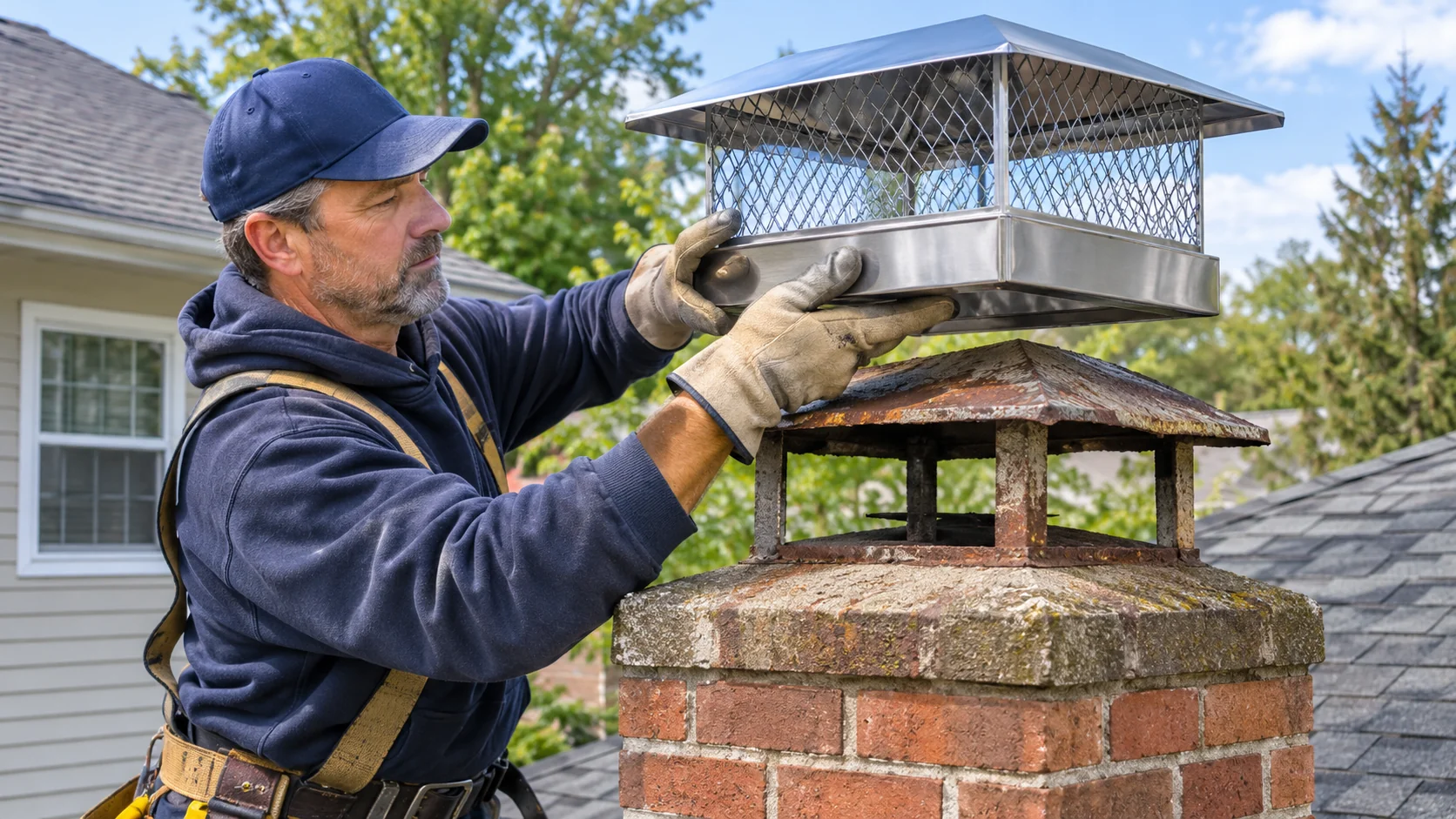
Key Takeaways
- Replace a chimney cap when it has holes, torn or missing mesh, rust that flakes, a bent frame, or keeps blowing off. Repair it when the problem is loose bolts, a small dent or surface rust.
- Stainless and copper caps can last for decades; galvanized caps wear out much sooner, especially on wood and oil flues.
- A cap that blows off was usually the wrong size, loose or fastened to a damaged tile. Fix the cause, not just the cap.
- Removing an old cap is usually a matter of loosening the bolts. Rusted bolts may need penetrating oil or cutting.
- Have the flue checked after any cap failure, because rain, debris or animals may have got in.
A chimney cap works quietly for years, and most people forget it is there until something goes wrong: water in the firebox, a bird in the living room, or the cap lying in the yard after a storm. Knowing when to repair a cap and when to replace it saves money and stops small problems becoming expensive ones. If the old cap was cheap and rusted fast, our best chimney cap picks focus on caps built to last.
This guide covers the signs of a failing cap, how long caps last, simple repairs, and step by step chimney cap replacement.
How Do You Know If Your Chimney Cap Is Damaged?
Check the cap from the ground with binoculars, from the roof if it is safe, and from inside the fireplace. Signs of damage include:
Visible Signs
- Rust on the hood, mesh or base, especially flaking rust.
- Holes in the hood or mesh.
- Bent, torn or missing mesh.
- A tilted or lifted lid.
- Gaps between the base and the flue tile.
- Rust streaks on the crown or brick below.
- Missing cap, blown off or removed.
Signs Inside the House
- Water in the firebox or on the damper after rain.
- Nesting material, feathers or droppings in the fireplace.
- Animal noises in the chimney.
- Musty or smoky odors.
- More smoke spillage than before.
How Long Do Chimney Caps Last?
Lifespan depends on material, fuel, climate and fit.
| Material | Typical life | Notes |
|---|---|---|
| Stainless steel | Decades | Often a lifetime limited warranty |
| Copper | Decades | Develops a protective patina |
| Galvanized steel | Shortest | Wears faster on wood, oil and coal flues and near the coast |
| Aluminum | Varies | Not for solid fuel or oil |
Caps fail early when they:
- Are the wrong size and rattle loose.
- Sit on a cracked tile or crown.
- Clog repeatedly with creosote, which holds acid against the metal.
- Are fastened with steel screws that rust.
How Often Should Chimney Caps Be Replaced?
There is no fixed replacement schedule. A stainless cap might never need replacing in the life of the chimney; a galvanized cap on a busy wood stove might need replacing every few years. Inspect the cap during your yearly chimney inspection, as NFPA 211 recommends, and replace it when you see the signs above.
Repair or Replace?
| Problem | Repair | Replace |
|---|---|---|
| Loose bolts | Tighten evenly | If the tile is broken or cap too big |
| Small dent in the lid | Straighten carefully | If the lid is cracked or misshapen |
| Surface rust | Clean, prime, paint (galvanized) | If rust flakes or holes appear |
| Torn mesh | Rarely repairable | Replace the cap |
| Missing cap | n/a | Replace |
| Wrong size | n/a | Replace with the right size |
| Clogged mesh | Clean | If it keeps clogging, consider larger or removable mesh |
Can a Chimney Cap Be Repaired?
Some problems can be repaired:
- Loose cap: tighten the bolts or band.
- Minor dents: gently straighten with hands or a rubber mallet.
- Surface rust on galvanized caps: clean, prime with galvanized metal primer and paint with high heat paint.
- Clogged mesh: clean it.
- Missing bolts: replace with stainless bolts of the same size.
Most other problems mean replacement. Patching mesh with wire or hardware cloth rarely lasts and can block airflow.
How to Fix a Loose Chimney Cap
A loose cap rattles in the wind and eventually blows off.
Step 1: Find Why It Is Loose
- Bolts backed off from vibration.
- Tile cracked or chipped where the bolts press.
- Cap too big for the tile.
- Band stretched or corroded.
Step 2: Tighten
If the bolts are simply loose, tighten opposite bolts a little at a time until the cap is snug and centered. Do not overtighten clay tiles.
Step 3: Fix the Cause
- Cracked tile: have the tile repaired or the top section replaced, or switch to a crown mounted cap.
- Cap too big: replace with the right size, which starts with knowing how to measure for a chimney cap.
- Worn band: replace the band or the cap.
How to Fix a Leaking Chimney Cap
If water drips from the cap or comes down the flue with a cap on, the cap may be too small, set too high, bent or clogged, or the leak may be from the crown or flashing.
How to Remove Rust from a Chimney Cap
Galvanized Caps
- Brush off loose rust with a nylon or stainless brush.
- Sand lightly to feather the edges.
- Wipe clean and let dry.
- Prime with a primer made for galvanized metal.
- Topcoat with high heat paint.
Do not paint over the mesh openings.
Stainless Caps
Brown staining on stainless is usually surface tea staining, from salt or iron particles. Clean with a stainless steel cleaner or a mild cleaner and a soft cloth. Never use steel wool or carbon steel brushes, which leave iron behind. If a stainless cap has real holes, it was likely a low grade.
Why Chimney Caps Blow Off
A cap that blows off in a storm usually had a fit or fastening problem:
- Wrong size: an oversized cap catches wind and twists.
- Loose bolts: vibration backs bolts out over time.
- Weak tile: bolts lose grip on cracked or crumbling clay.
- Friction fit only: some caps rely on a snug fit that loosens.
- Large lid in an exposed spot: high wind lifts it.
When you replace a blown off cap, fix the cause: correct size, sound tile, all bolts tight, and in very windy spots consider a cap with a stronger base or band.
Why Does My Chimney Cap Keep Blowing Off?
If a cap blows off more than once, it is almost certainly the wrong size, sitting on damaged masonry or not designed for the wind exposure. Have a sweep check the tile and crown. Consider a multi flue style cap anchored to the crown, a cap with a locking band such as the HY-C Shelter Pro, or a low profile design.
How to Remove a Chimney Cap
Step 1: Prepare Safely
Dry, calm day, secured ladder, roof harness on steep or high roofs, cold chimney. See the safety section in how to install a chimney cap.
Step 2: Loosen the Fasteners
Loosen the bolts, screws or band. On metal chimneys, remove the screws and twist the cap to unlock it.
Step 3: Deal with Rusted Bolts
Spray rusted bolts with penetrating oil and wait 15 minutes. Try again. If they still will not turn, cut them with a hacksaw or oscillating tool, taking care not to damage the tile.
Step 4: Lift the Cap Off
Lift straight up. Clay tiles can be fragile, so do not lever the cap off sideways.
Step 5: Lower It Safely
Lower the old cap with a rope or place it in a bag. Do not throw it off the roof.
How to Replace a Chimney Cap Step by Step
Step 1: Measure the Flue
Measure while the old cap is off. Do not assume the old cap was the right size.
Step 2: Inspect the Flue
Look for creosote, nests, cracked tiles and crown damage. Have the chimney swept if needed.
Step 3: Clean the Tile
Brush off rust, old mortar and debris where the new cap will sit.
Step 4: Fit the New Cap
Set it level, center it and tighten the fasteners evenly.
Step 5: Check It
Make sure it does not move and there are no gaps. Watch the first fire on a calm day.
Upgrading When You Replace
Replacement is a good time to upgrade:
- Galvanized to stainless for a longer life.
- Single flue caps to a multi flue cap if the crown is cracked or flues are close.
- 3/4 inch to smaller mesh if a spark arrestor is now required.
- Standard cap to a wind cap if downdraft is a problem.
- To a top mount damper cap if heat loss when the fireplace is off is a concern.
Replacing Caps on Prefab Chimneys
On prefab and Class A chimneys, replace the cap with the one listed for that pipe. Find the brand, model and size on the fireplace label or pipe. If the original is discontinued, ask the maker or a sweep for an approved replacement.
What to Check After a Cap Failure
If a cap has been missing, loose or damaged for a while, check:
- The flue for nests, debris or water damage.
- The damper for rust.
- The smoke chamber for animal nests.
- The crown for cracks.
- The firebox for water damage.
A sweep can inspect with a camera.
Chimney Cap Replacement Cost
Replacement costs about the same as a new cap installation, which HomeGuide puts at $200 to $850 for most jobs, plus any removal and repair work.
Can a Chimney Cap Be Replaced in Winter?
Yes, on a dry, calm day with no ice or snow on the roof and a cold chimney. A missing cap in winter lets snow and animals in, so do not wait for spring if a cap has blown off. A sweep can often fit a temporary cap until the right one arrives.
Choosing the Replacement Cap
Do not just buy the same cap again. Ask why the old one failed and choose a cap that solves it.
| Why the old cap failed | Choose |
|---|---|
| Rusted through | Stainless or copper |
| Blew off | Correct size, stronger fastening, banded or crown mounted |
| Clogged often | Larger mesh where allowed, removable screen |
| Animals got past it | Heavy gauge, gap free fit |
| Rain still got in | Wider lid, multi flue cap over the crown |
| Downdraft | Wind directional or draft inducing cap |
| Heat loss when not in use | Top mount damper cap |
| Spark rules changed | Spark arrestor mesh that meets local code |
Replacing Specific Cap Types
Replacing a Single Flue Cap
The most common job. Remove the old cap, measure the flue tile, buy the correct size and fit it as described above.
Replacing a Multi Flue Cap
Multi flue caps are anchored into the crown. Removing one means unbolting or cutting the anchors. Inspect the crown, because it is now uncovered and easy to repair. Measure the crown and all flues, then order the new cap, which is often made to measure.
Replacing a Top Mount Damper Cap
Damper caps have a cable that runs down the flue to a handle in the firebox. Replacement involves removing the cable and handle and fitting the new unit. Many sweeps handle this job, because the cable needs careful routing and the seal must be checked.
Replacing a Rotating Wind Cap
Some rotating caps allow you to replace only the bearing or the rotating head. Check with the maker before replacing the whole unit.
Replacing a Prefab Chimney Cap
Use the cap listed for the chimney system. If the system has been discontinued, ask the maker or a sweep for an approved replacement. Using an unlisted cap can affect the listing of the chimney.
DIY or Professional Replacement?
| Situation | DIY | Professional |
|---|---|---|
| Single flue cap on a low, gentle roof | Often possible | Optional |
| Steep or high roof | Not recommended | Yes |
| Rusted bolts that need cutting | Possible with care | Recommended |
| Multi flue cap | Difficult | Yes |
| Damper cap | Difficult | Yes |
| Cracked tile or crown | No | Yes |
| Suspected animals | No | Wildlife professional |
Professional installation also gives you an inspection of the chimney at the same time, which is useful after a cap failure.
Warranty Claims
Many stainless and copper caps come with a limited lifetime warranty. Before buying a new cap:
- Find the brand and model, often stamped on the cap or in your records.
- Read the warranty terms. Many cover rust through or defects but exclude storm damage, improper installation, chimney fires or animal damage.
- Take photos of the damage.
- Contact the maker or the retailer.
A warranty may cover the cap but not installation labor.
Storm Damage and Insurance
If a storm blew off your cap or a tree branch crushed it, your homeowners insurance may cover it as part of storm damage. Policies vary, and the cost of a cap may fall below your deductible. Photograph the damage and check your policy. Wear and tear, rust and poor installation are usually not covered.
HOA and Neighborhood Rules
Some homeowner associations have rules about visible roof items, including chimney caps, shrouds and colors. Check before choosing a copper cap, decorative shroud or colored finish.
What to Do with the Old Cap
- Stainless and copper caps have scrap value at a metal recycler.
- Galvanized caps can go to scrap metal recycling.
- Do not throw an old cap off the roof. Lower it with a rope or carry it down in a bag.
- If the old cap is heavily coated in creosote, wrap it before transport to keep residue off your car.
Replacement Checklist
- Inspect and photograph the old cap.
- Find out why it failed.
- Remove it safely.
- Measure the flue or crown.
- Inspect the tile, crown and flue.
- Have the chimney swept if needed.
- Choose a replacement that fixes the cause.
- Install and tighten evenly.
- Check the fit and watch the first fire.
- Add the cap to your yearly inspection routine.
How Long a Replacement Takes?
A straightforward single flue cap replacement can be done in a short visit, often under an hour on the roof. Multi flue and damper caps take longer, especially if the crown needs repair or the cap must be made to measure. Custom caps can take extra time to fabricate, so measure early if you want the work done before the heating season.
Replacement Questions Homeowners Ask
Should I Replace the Cap and Crown at the Same Time?
If the crown is cracked, yes. With the old cap off, the crown is easy to reach and inspect. Repairing or sealing it first, then fitting the new cap, avoids a second trip and stops water working into the cracks under a brand new cap.
Should I Replace the Cap Before Selling My House?
A rusty or missing cap is often flagged in home inspections. Replacing it with a correctly sized stainless cap is a small job that removes an easy objection, and the receipt shows the chimney has been maintained.
Do I Need a Permit to Replace a Chimney Cap?
Replacing a cap with a similar one is usually treated as routine maintenance. Some areas have rules for spark arrestors or historic districts. If in doubt, ask the local building department.
Can I Put a Bigger Cap on to Stop Leaks?
Only if it still fits the flue correctly. A cap that is too big sits loose and can blow off. If you need more coverage, use a correctly sized cap with a wider lid, or a multi flue cap designed to cover the crown.
What If the Flue Tile Is Broken Off Below the Crown?
A single flue cap cannot clamp to a broken tile. The tile must be repaired or replaced, or a crown mounted cap used instead. A sweep or mason should look at it, because a broken tile can also mean damage further down the flue.
Signs the New Cap Was Installed Correctly
- It sits level and centered.
- It does not move when pushed firmly.
- The mesh is intact all around with no gaps at the base.
- The fireplace draws normally on the first fire.
- No rattling or whistling in wind.
- No water in the firebox after the next heavy rain.
If any of these fail, fix the fit straight away, before the next storm.
The Bottom Line
Repair a chimney cap when bolts are loose, dents are minor or galvanized rust is only on the surface. Replace it when it has holes, torn mesh, flaking rust, a bent frame, the wrong size, or keeps blowing off. When you replace it, fix the cause, measure the flue, check the chimney, and consider upgrading to stainless.
Frequently asked questions
How long do chimney caps last?
Stainless steel and copper caps can last for decades. Galvanized caps last much less, often only a few years on wood or oil flues.
How often should chimney caps be replaced?
There is no fixed schedule. Replace a cap when inspection shows holes, flaking rust, torn mesh, a bent frame, or when it no longer fits securely.
Can a chimney cap be repaired?
Minor problems such as loose bolts, small dents and surface rust can be repaired. Holes, torn mesh and badly rusted caps should be replaced.
How do you fix a loose chimney cap?
Tighten the bolts or band evenly. If the bolts will not grip because the tile is cracked or the cap is the wrong size, repair the tile or replace the cap.
How do you remove a chimney cap?
Loosen the bolts, screws or band, then lift the cap straight up. Use penetrating oil on rusted bolts, and lower the cap carefully with a rope.
How do you know if your chimney cap is damaged?
Look for rust, holes, bent or missing mesh, a tilted lid, gaps at the base, animals getting in, or water in the firebox.